Introduction
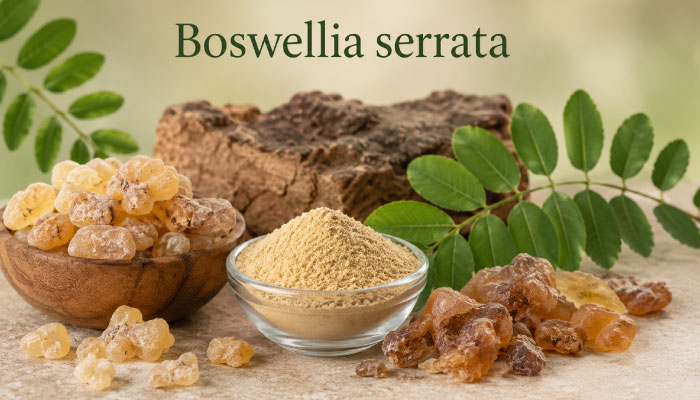
Boswellia serrata known as Indian frankincense or Shallaki in Ayurvedic medicine is one of the most widely used botanical ingredients in nutraceuticals for joint health, inflammation management, and musculoskeletal support. Its active constituents, the boswellic acids, have been studied for a range of biological activities: anti-inflammatory, antioxidant, and neuroprotective effects have all been documented in scientific literature.
It is critical to evaluate Boswellia serrata ingredient from its chemistry to its clinical evidence that supports formulators, healthcare professionals, and brands alike.
Step 1: What Are Boswellic Acids?
Boswellic acids are naturally occurring pentacyclic triterpenoids from the oleo-gum resin of Boswellia serrata.
- BA — Beta-boswellic acid (β-boswellic acid)
- ABA — Acetyl-beta-boswellic acid
- KBA — 11-keto-β-boswellic acid
- AKBA — 3-O-acetyl-11-keto-β-boswellic acid
- α-boswellic acid and acetyl-α-boswellic acid
Of these, KBA and AKBA have received the greatest scientific attention and are the two compounds most relevant to ingredient evaluation.
KBA (11-keto-β-boswellic acid) is one of the primary bioactive boswellic acids and is recognised as a biologically active precursor structurally related to AKBA.
AKBA (3-O-acetyl-11-keto-β-boswellic acid) has been extensively studied since the 1990s, when research identified it as a potent and selective inhibitor of 5-LOX (5-lipoxygenase). 5-LOX is the enzyme responsible for the biosynthesis of leukotrienes, a key class of pro-inflammatory mediators implicated in joint inflammation, airway inflammation, and inflammatory bowel conditions. This discovery made AKBA the most investigated boswellic acid and the principal marker for Boswellia extract standardisation.
Step 2: Check AKBA Standardisation The Quality Marker
Boswellia serrata resin contains only 1% to 3% AKBA highly variable commercially. Variability in AKBA content is key to standardisation.
Ingredient check should include the following:
- AKBA concentration in Boswellia ingredient – typically 20% to 60%+
- Specification – Reference of “65% Total Boswellic Acids” without stating AKBA content separately — total boswellic acids can include less active or inactive isoforms. AKBA concentration, is the number that most directly correlates with 5-LOX inhibitory potency
Key principle: Higher AKBA standardisation allows a lower effective dose while maintaining therapeutic activity important for formulation economics and consumer compliance.
Step 3: Evaluate the Formulation and Bioavailability Technology
A well-standardised extract may underperform if the body cannot absorb it effectively. Boswellia serrata bioactives, particularly AKBA, has inherent bioavailability challenges:
- Low aqueous solubility boswellic acids are lipophilic and poorly soluble in gastrointestinal fluids
- Limited gastrointestinal permeability restricted passive absorption across the intestinal membrane
- Extensive first-pass metabolism significant hepatic degradation before systemic circulation is reached
The formulation technology behind a Boswellia ingredient directly determines how much of the standardised AKBA actually reaches systemic circulation. Key technologies to understand:
Phytosome Technology Complexing boswellic acids with phospholipids such as phosphatidylcholine improves membrane permeability and intestinal absorption by mimicking the body’s own lipid membrane environment.
Non-Volatile Oil Enrichment Combining AKBA-rich extract with the plant’s own non-volatile oils enhances systemic bioavailability of AKBA — the mechanism behind fast-onset ingredients that demonstrate measurable joint comfort improvement within 5 to 7 days of supplementation.
Molecular Energization (EASI™) A novel approach that works at the crystal lattice level: bioactive compounds are exposed to calibrated electromagnetic fields (80 MHz to 1 GHz; PEMF at 60 A/m, 75 μT) to shift their molecular arrangement into a more bioactive state. The energy is stored within the molecular structure and released at the site of biological action.
Advanced Delivery Systems (Research Stage) Emerging technologies under investigation include polymeric nanoparticles (chitosan, PLGA), solid lipid nanoparticles (SLNs), nanoemulsions, liposomes, and polymeric micelles — all designed to further enhance solubility, protect bioactives against enzymatic degradation, and enable sustained release.
Step 4: Review Clinical Evidence Quality Over Volume
Boswellia serrata has an established safety record backed by centuries of traditional Ayurvedic use and robust toxicological data, the focus of clinical evaluation shifts to efficacy
What to look for in clinical evidence:
- Study design: Randomised, double-blind, placebo-controlled trials (RCTs) are the gold standard
- Validated outcome measures: Look for recognised clinical endpoints such as WOMAC (Western Ontario and McMaster Universities Osteoarthritis Index), VAS (Visual Analogue Scale for pain), MMP-3 (matrix metalloproteinase-3 for cartilage degradation), and BASDAI (Bath Ankylosing Spondylitis Disease Activity Index)
- Onset time: Premium ingredients demonstrate measurable effects within days to weeks not months
- Safety reporting: Zero adverse events across the study duration is a meaningful quality signal
Step 5: Demand Analytical Verification and Traceability
A specification sheet is only as reliable as the analytical methods behind it. Robust branded ingredients are supported by:
- HPLC (High-Performance Liquid Chromatography) or HPTLC (High-Performance Thin Layer Chromatography) for chemical fingerprinting, species authentication, and batch consistency verification
- Certificate of Analysis (CoA) confirming absence of heavy metals, pesticides, residual solvents, and microbial contamination
- GMP-certified manufacturing Good Manufacturing Practice certification provides a baseline quality assurance framework
- Batch-level traceability from botanical sourcing through finished ingredient — increasingly important for regulatory compliance and consumer trust
Conclusion: The Evaluation Checklist
When assessing any Boswellia serrata ingredient, work through these five criteria in order:
- AKBA content — stated, minimum-guaranteed, and primary in the specification
- Formulation technology — what delivery mechanism is used to overcome bioavailability limitations
- Clinical evidence — RCT design, validated endpoints, onset time, and safety data
- Analytical verification — HPLC/HPTLC, CoA, GMP certification, batch traceability
- Boswellic acid profile — does the specification account for the complementary activity of boswellic acids, or only AKBA?
The ingredient behind the label matters. Boswellia serrata has earned its credibility through millennia of use and decades of modern science. A well-evaluated ingredient ensures that credibility translates into the capsule.

Author : Ms.Tahira H S – Chief research officer